

Master AI interaction using The Prompt Designer by Graciano Mora, a complete guide available now on Amazon.
Welcome back to the Concha Solutions LLC blog here in West Palm Beach, Florida. At Concha Solutions, we believe that while tools constantly change, the fundamentals of craft remain entirely steady. When working with artificial intelligence, knowing how to communicate your exact intent makes all the difference between receiving generic output and generating genuinely useful results. Whether you are building workflows, writing content for work, or exploring everyday applications, understanding the mechanics of communication helps you get the most out of your tools.
Understanding How Prompts Work
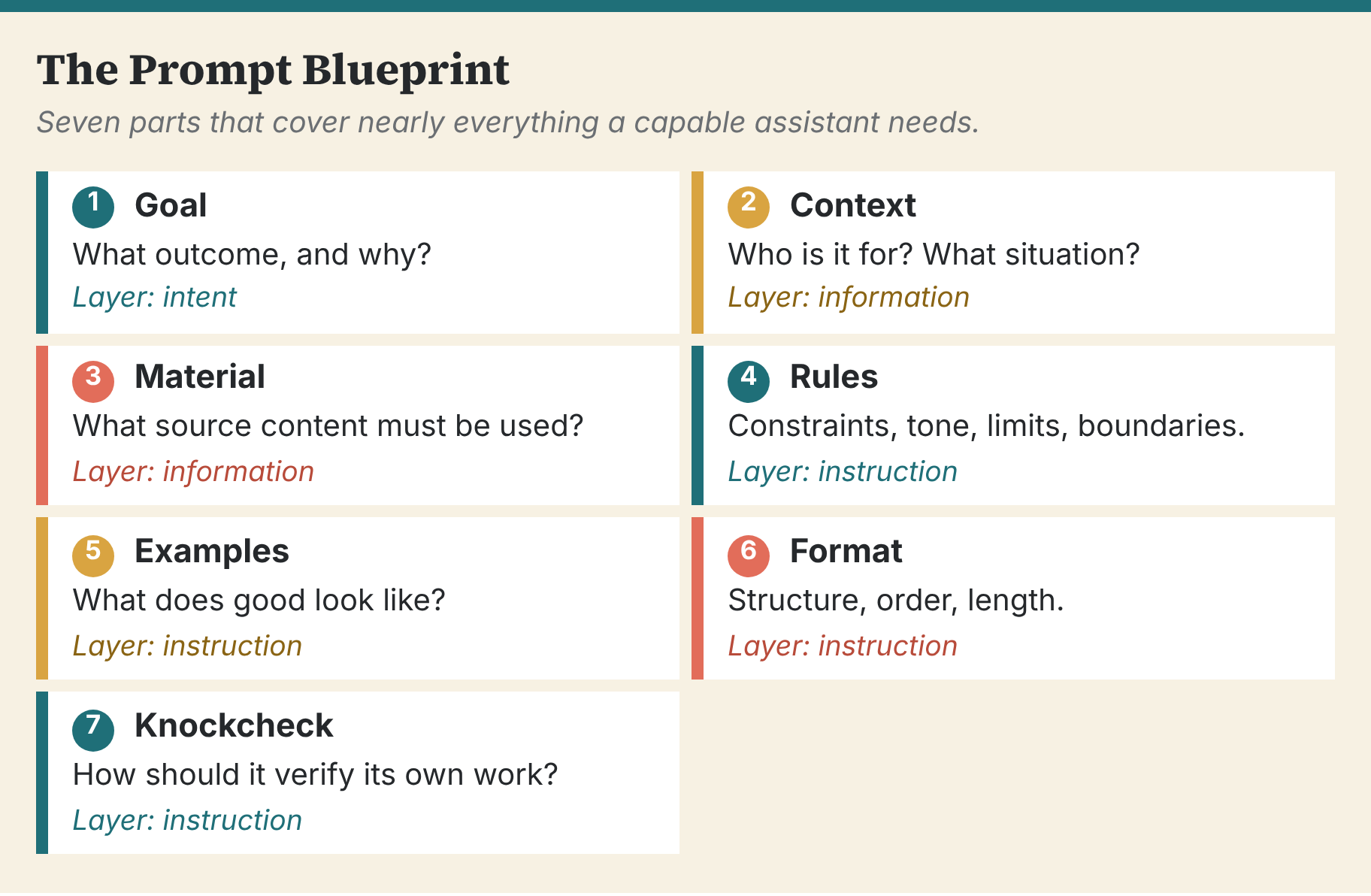
Writing effective prompts is a skill that blends clear thinking with structured instructions. To help you structure your requests properly, the book introduces a robust seven-part Prompt Blueprint. This framework breaks down instructions into distinct components: Goal, Context, Material, Rules, Examples, Format, and Knockcheck. By systematically addressing each of these parts, you ensure that the AI model understands not just what you want, but the boundaries, background information, and output style required for the task.
To give you a better idea of how these elements come together, here is a helpful visual diagram illustrating how requests are structured using this method:
Beyond the core blueprint, the material covers a short history of prompting tracing the evolution from ELIZA to modern context engineering. It also includes image and video prompt formulas, twelve specific techniques categorized into four distinct families, and ten essential do’s and don’ts to keep your interactions on track.

Core Takeaways for Better Prompting
If you want to improve your day-to-day interactions with AI platforms, keeping a few practical guidelines in mind will immediately elevate your results. Here are some concrete takeaways drawn directly from the text:
- Always define a clear, singular goal before writing your instructions so the model does not wander off-topic.
- Provide sufficient background context and source material to ground the AI’s response in reality.
- Use the seven-part Prompt Blueprint (Goal, Context, Material, Rules, Examples, Format, Knockcheck) to structure complex requests.
- Incorporate specific formatting rules to ensure the output matches your exact presentation needs.
- Test and repair your prompts using a methodical, single-variable approach when the output does not meet your expectations.
- Apply platform-specific playbooks tailored for different systems like ChatGPT, Gemini, Claude, Copilot, Perplexity, Grok, Meta AI, and DeepSeek.
Navigating Platforms and Safety
Different AI platforms interpret instructions and handle context windows in unique ways. That is why having a grasp of various systems is so valuable. The book features dedicated platform playbooks for ChatGPT, Gemini, Claude, Copilot, Perplexity, Grok, Meta AI, and DeepSeek, helping you adapt your prompting style to whichever tool you happen to be using.
Furthermore, interacting with artificial intelligence responsibly requires an understanding of digital safety and information ethics. A dedicated chapter explores crucial topics such as safety, privacy, prompt injection, and ethics. Coupled with 33 original charts and diagrams throughout the 226 pages, along with questions and exercises in every chapter, this guide gives you the foundational knowledge needed to communicate safely and effectively in any professional or personal setting.
Get the Book
Ready to refine your interaction skills and write better instructions for your daily projects? You can find the complete guide on Amazon. Get your copy of [The Prompt Designer on Amazon](https://link.amazon/B0erGGvlW) today.
Also by Graciano Mora: Be sure to explore his other related works, available on Amazon as [The AI Logo Designer on Amazon](https://link.amazon/B0cMu7Yb9) and [The AI-Driven Designer on Amazon](https://link.amazon/B06Rcmqdo).

